Question 5.1 - CONCEPT TESTING - 1 CONCEPT
MY GAP
Salt dispenser that dispenses a set amount of table salt consistently
PRIMARY USER NEEDS
* Salt dispenser handles most sizes & types of table salt
* Salt dispenser handles changing needs of the amount of salt
* Salt dispenser is being used in any kind of environment
* The amount of salt being dispensed is visible
* Salt dispenser is user friendly
* Salt dispenser is ergonomically designed
* Salt dispenser is visually appealing
* Salt dispenser is small
* Salt dispenser is light weight
* Salt dispenser is simple and easy to assemble
* Salt dispenser is easily available
1. THE CONCEPT BEING TESTED
- I am pursuing the concept F (Twist - Escape) based upon the feedbacks and comments I received.
- I have refined some features based upon the feedback I received.
- I will have a large distribution cone instead of a distribution system made up of small cones.
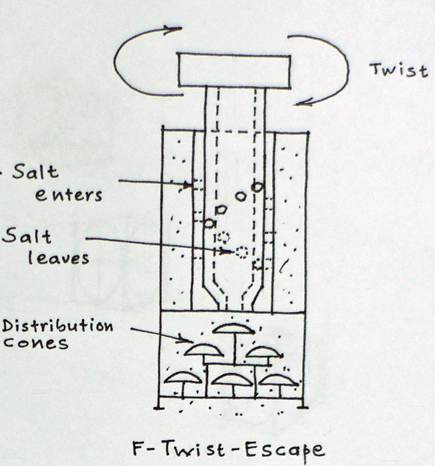
This is the original concept F without the refinements.
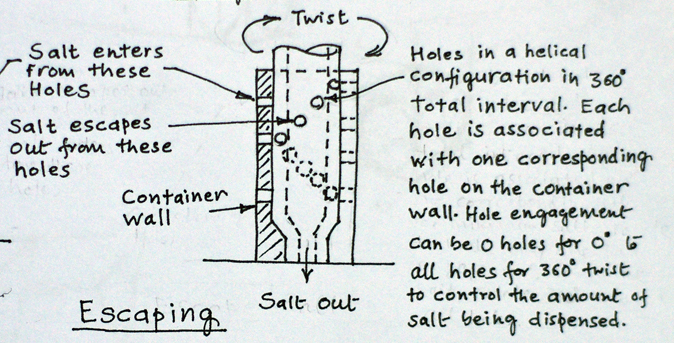
The following is concept F with some refinements. When the black cover is turned by one turn (360 degree), each hole on the red tube (explained below) gets a chance to engage with a corresponding hole on the outside white tube. This is how the salt in the container gets a chance to escape out of it when there is a hole engagement on both the tubes. The escaped salt, thru the red tube, falls on the distribution cone and finally on to the food below. One turn of the black cover is one serving of the salt. You repeat the process to get more servings of salt. How to adjust the amount of the salt in one serving is explained below.
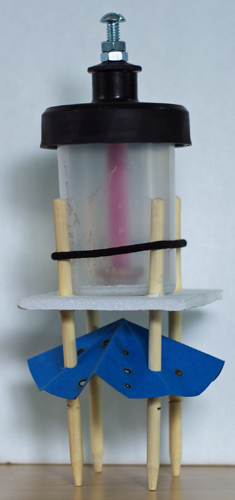
The following is a view with opened salt dispenser. There are two tubes, a white and a red. White is attached to the salt container (it is fixed with the container and does not move) and red is attached to the black cover. There is a nut & screw mechanism attached to the top of the red tube. The red tube is tightly attached to the black cover but can be moved up or down using the nut - screw assembly. When you move the red tube up, there will be less holes on the red tube that will get engaged with the corresponding holes on the white tube in one turn of the black cover. So less amount of salt will get a chance to escape out of the salt container in one turn of the black cover. When you move the red tube down, there will be more holes on the red tube that will get engaged with the corresponding holes on the white tube in one turn (360 degree) of the black cover. So more amount of salt will get a chance to escape out of the salt container in one turn of the black cover. This is how the amount of salt being dispensed in one turn of the black cover is controlled. The holes are big enough so that salt with almost all grain sizes will pass thru these holes. In humid environment the salt gets clumped but the fixed white tube and the red turning tube would create a kind of grinding action. When a clump of salt comes across the two holes, this grinding action between the two tubes would beak the clump into smaller pieces that would pass thru the holes. The distribution cone would be of darker color (may be black, brown, dark blue) so white salt would easily be visible when the salt falls on the cone. This would give you a visual sense of how much salt is coming out of the dispenser in each serving so you can increase or decrease the amount of salt per serving.
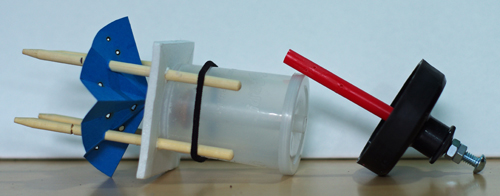
Below is my basic idea of how salt would come out of the salt container.
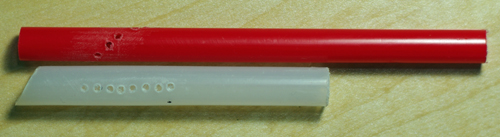
This are the two tubes that I have used here. The holes on the red tube are equidistant and in 360 degree helical configuration. The holes on the white tube (red tube goes inside this white tube) are in one line so that at any moment there is only one hole on the red tube that will get engaged with only one corresponding hole on the white tube. A full 360 degree turn of the red tube would give a chance to each hole on this tube to get engagement with the corresponding hole on the white tube. With this scenario, maximum amount of salt would be dispensed in one turn of the black cover. When the red tube is moved up using the nut - screw mechanism, there will be less number of holes that would get engaged with the corresponding holes on the white tube there by dispensing less amount of salt in one turn (one serving).
2. DESCRIPTION OF THE CONCEPT TESTING PROCESS WITH THE TARGET USERS
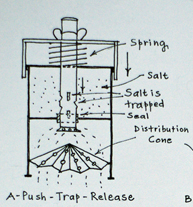
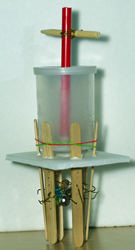
I presented the following four concepts & prototypes (that I prepared during week 3 & 4) to my friends and neighbors (my target users) and explained them how the four work before I conducted a survey.
A : Push - Trap - Release
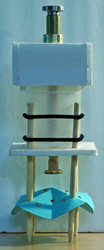
D : Pull - Trap - Drop
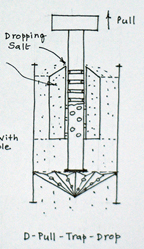
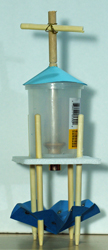
E : Pull - Escape & F : Twist - Escape
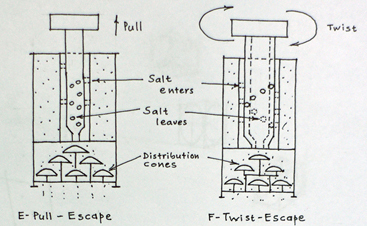
E : Pull - Escape
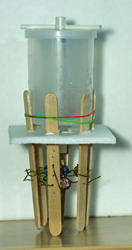
F : Twist - Escape
I asked everyone (a total of 12 people) the following question.
If you have to choose one salt dispenser, which one would you choose?
The following is my survey result.
| Concept selection survey | |||||
| Concepts | |||||
| Person# | A : Push - Trap - Release | D : Pull - Trap - Drop | E : Pull - Escape | F : Twist - Escape | Person's comment |
| 1 | 1 | ||||
| 2 | 1 | ||||
| 3 | 1 | ||||
| 4 | 1 | Prefer with one distribution cone | |||
| 5 | 1 | ||||
| 6 | 1 | ||||
| 7 | 1 | ||||
| 8 | 1 | ||||
| 9 | 1 | ||||
| 10 | 1 | Big distribution cone would be better | |||
| 11 | 1 | ||||
| 12 | 1 | Would like one distribution cone | |||
| Total | 3 | 2 | 3 | 4 | |
As you can see four liked F, 3 liked A & E each and 2 liked D. The four persons liked F because of the simple turning movement to dispense the salt; the other three prototypes requires pull or push. Seven people liked my idea of using the two tubes and holes method for the salt to come out of the container. Three people also commented about changing the distribution system made up of small multiple cones in E & F to a large distribution cone. Everyone liked my idea of controlling the amount of salt being dispensed per serving.
CONCLUSION
Based upon the feedbacks and comments that I received, I believe choice F is a clear winner with a distribution cone system. I will continue for the rest of the weeks with choice F with a modification of replacing the distribution system with a large distribution cone. I have covered my important primary needs with this prototype and will continue adding the remaining less important primary needs during alpha & beta development processes.